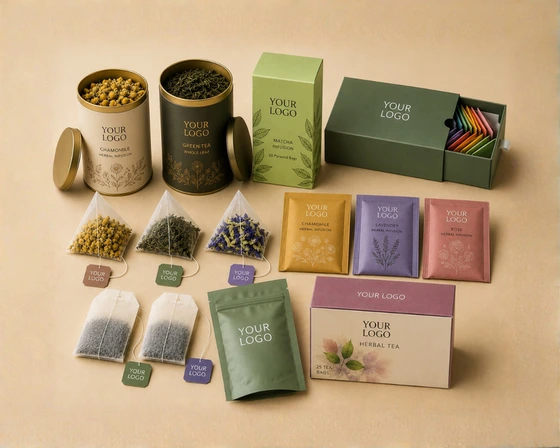
Define the opportunity.
Product, target market, format, quantity and budget. Agree a quoted minimum that includes the relevant fill, film, caps, labels and cartons.
 Good For Nature · Good For You
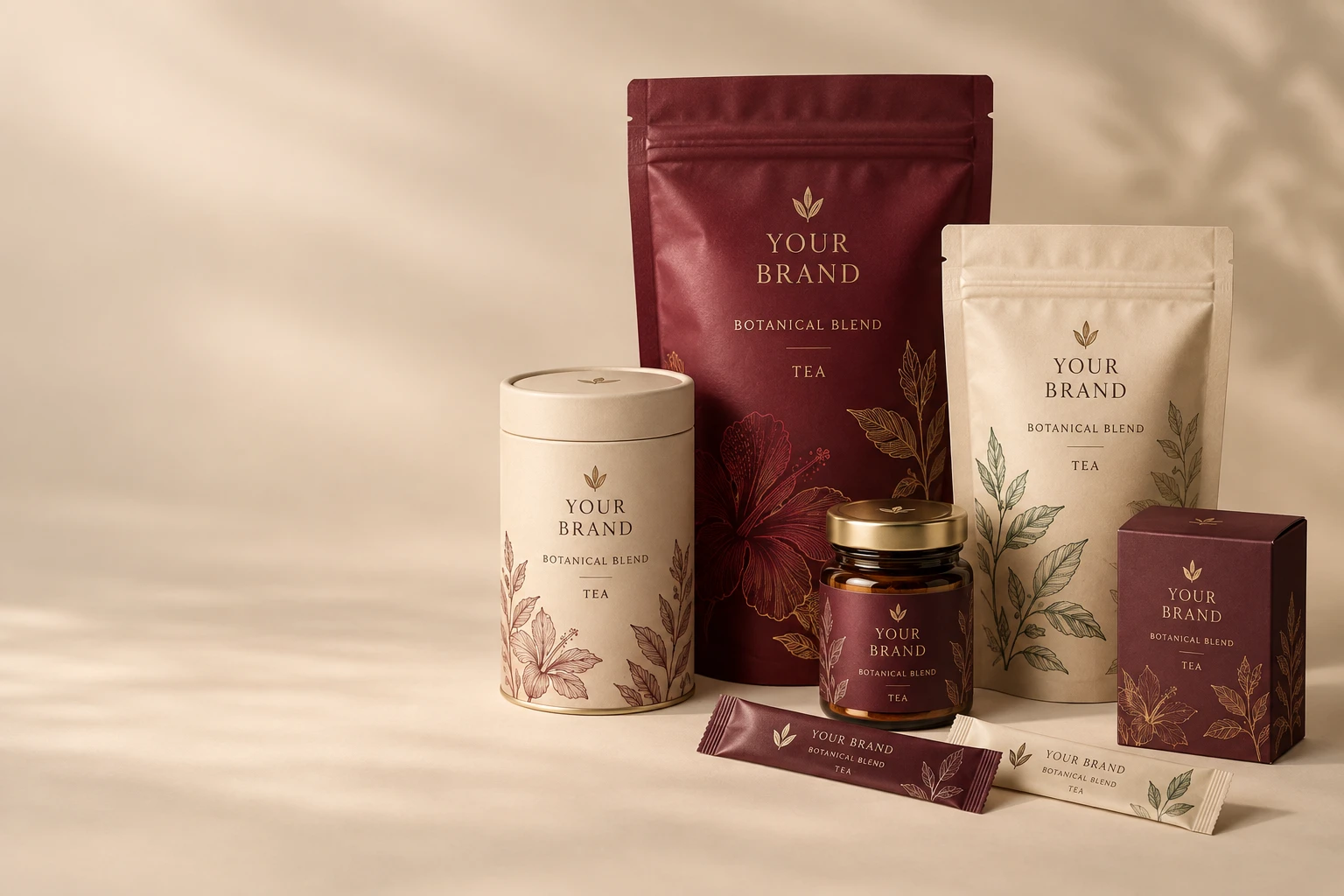
Develop the ingredient. Refine the formulation. Create the pack they reach for again.
Your personal ingredient scientist, from the first botanical to your finished brand.
A fine powder, a fragrant tea and a whole botanical behave differently. We start with the material, then build the pack around protection, portion and presentation.
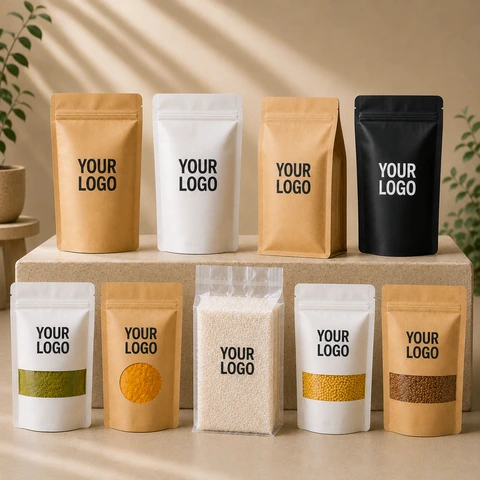
Tea-bag fills from 1 g to 2.5 g. Choose 10, 15, 20, 25 or 30 bags per box. Match the cut and fill to the blend’s density and brewing performance.
Most ingredients1 · 5 · 10 · 25 kg
Leafy materials1 · 5 · 10 · 20 kg
Flowers1 · 5 · 10 kg
These are ingredient-supply pack options. Private-label production minimums are quoted separately for the complete product and packaging system. Explore bulk ingredients ↗
What your customer sees. What keeps the material protected. What makes the next opening feel just as considered.
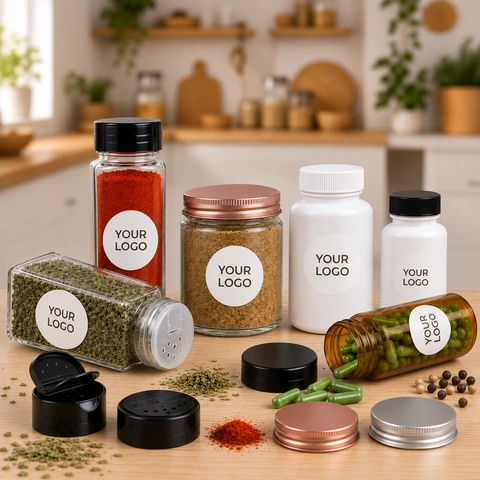
Induction seals, desiccants, tamper evidence, nitrogen flushing and vacuum packing can be specified where suitable for the ingredient and format. Agree barrier needs and shelf-life evidence before the final pack is selected.
Custom labels or pre-printed packs, supported by artwork development. Explore matte, spot-UV, foil, embossed and metallic finishes. Review a physical proof before committing to production.
Plan barcode placement, batch coding, ingredients and destination-market label content together. Confirm the approved artwork version and the information that changes with each batch.
Discuss recyclable and mono-material options alongside the barrier performance your formulation needs. The final material, closure and local disposal route determine the suitability of any recycling claim.
Design the consumer unit, the outer carton and the shipment as one connected system. A beautiful pack should arrive beautifully, too.
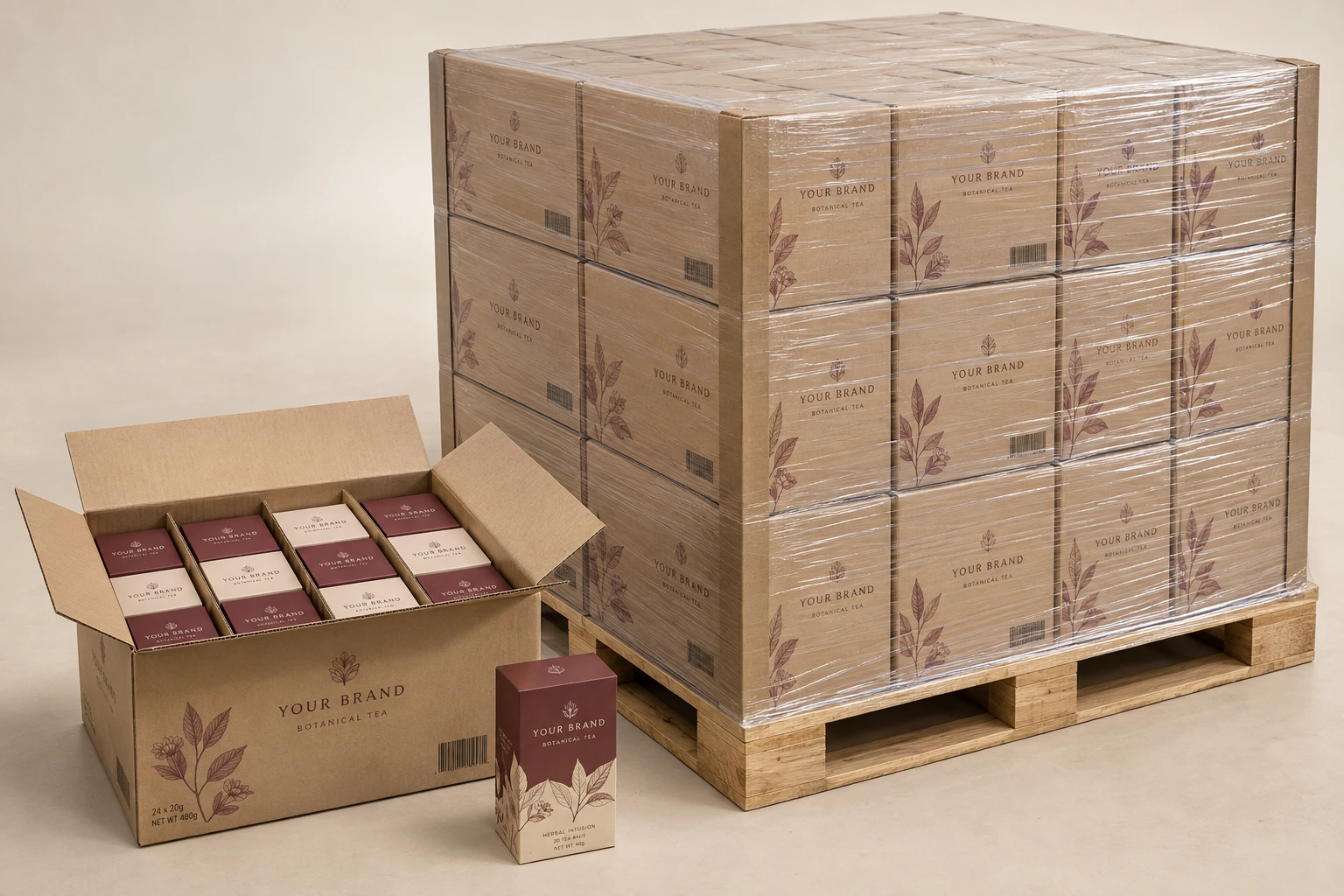
Retailer names describe your intended destination, not an affiliation or blanket approval. Current buyer and fulfilment instructions form part of the final packaging brief.
Start with an idea, an existing formula or a product you want to improve. We bring ingredient development and packaging into the same conversation.
Product, target market, format, quantity and budget. Agree a quoted minimum that includes the relevant fill, film, caps, labels and cartons.
Develop the sample, refine sensory performance and confirm the ingredient specification. Agree ownership and confidentiality for exclusive formulations.
Review pack sizing, artwork, market-fit and the physical sample. Confirm the approved specification and production plan together.
Release the bulk material before packing. Verify the finished fill, seal and label, then release the batch with its agreed documentation.
Tea bags hold 1–2.5 g, with 10, 15, 20, 25 or 30 bags per box. Pouches, bottles, tins, canisters, sticks and outer cartons are sized to your product and brief. We confirm physical fit using the actual material because equal weights of leaf, flower and powder occupy different volumes.
The minimum is quoted for your complete project, including the material and the chosen packaging components. It depends on formula, print method, closures and pack format. Ingredient-supply minimums do not automatically apply to finished private-label products.
Both can form the starting point. Share your target application, sensory requirements, benchmark and market. Development, exclusivity, confidentiality and final specifications are agreed before production.
Share the current fulfilment or buyer packaging brief with us. We review unit preparation, labels, outer cartons and the pallet or display configuration for that destination. Final acceptance depends on the current retailer requirements and agreed shipment plan.
Agree the document set during approval, including the applicable lot COA and export documents. Product, facility and batch documents can also be requested through your Root2Leaf account.
Lead time is confirmed with the formula, material availability, packaging procurement and artwork approval. Review the sample and proof first; the agreed order records the production and dispatch schedule.
Tell us the product, market, format, quantity and budget. A relevant product specialist will help shape the next step.